
A Deeper Look at the Northern Valley Greenway

The Northern Valley Greenway is a proposed 7.4-to-8-mile multi-use trail that would transform an abandoned CSX freight rail corridor into a linear park directly connecting six Bergen County boroughs and another dozen through separate connections.
Spanning Tenafly, Cresskill, Demarest, Closter, Norwood, and Northvale, the corridor is roughly 60 feet wide, follows the old Northern Branch rail line, and has been sitting dormant, dilapidated, and purposeless for decades.
However, a project of this scale has a lot of legal, financial, environmental, and political machinery underneath it, and most of those deeper intricacies surrounding the project are not easily visible from the outside.
To get past the project’s surface, I sat down with NVG team leader Andrew Mikesh and Chad Coleman, one of Tenafly’s representatives to the NVG committee.
What follows is a rundown of what they told me, including the parts that don't have clean answers yet.
Planning and Land Acquisition
The NVG is definitely well past its initial brainstorming phase, and a tentative design and plan have already been hammered out. Groundwork in the form of a formal NJDOT Technical Planning Assistance Study completed in 2019 by engineering firm NV5, a stakeholder workshop in September 2018 that drew 81 participants, and a public information session in March 2019 that brought out 334 residents, hammered out both hard facts and tentative project designs with input from the affected community. The NVG already has years of work done by volunteers and professionals, and interest from stakeholders, under its belt.
But nailing down the current phase still requires some nuance. "I would say it's still in planning and land acquisition strategies," Mikesh told me. "We never actually came up with a formal name for the phase we're in, but it's land acquisition." The corridor, approximately 65 acres of right-of-way, is currently owned by CSX Transportation, and until that land is secured, very little in-depth planning can formally move forward.

Mikesh was quick to push back, though, on the idea that acquisition is the hardest part ahead. "It depends on how you define complicated," he said. "It's definitely our biggest challenge so far. But I could also see that developing a detailed construction plan for 65 acres, where we hope to literally do construction border-to-border, can be much more complicated.” The NVG’s sheer scale would necessitate the balancing of interests and considerations of a whole region, further complicating the design and construction process.
The CSX Negotiation
When I asked Mikesh to rate progress on the CSX acquisition on a scale of zero to ten, he put it at a six. His rating, which on the surface suggests that the acquisition is approaching its conclusion, doesn’t actually indicate that a final deal is close.
"It takes a long time to get the railroad interested,” Mikesh said. “Then we have to figure out what they want, negotiate, and then do due diligence." Land acquisition is a lengthy multi-phase process which is likely to continue for a few more years, according to Mikesh.
The NVG committee, the project’s governing body consisting of representatives from each participating municipality, has brought in the same team of lawyers, appraisers, and negotiators that handled the Essex-Hudson Greenway acquisition. Mikesh confirms that this was a necessary choice, as railroad transactions are governed by a dense body of federal law that volunteers simply can't navigate. "We made a decision that we got to a point where we need professionals," Mikesh said.
Other greenway projects the NVG takes inspiration from, and likely the NVG itself, use a legal mechanism being pursued is called “rail banking.” Under federal law, a railroad can sell or transfer a corridor to a trail sponsor, but retains the right to reclaim it if it is ever needed for public transportation in the future. Note that historically, corridor reclamation post-railbanking and greenway construction is extremely rare. At that point, re-building a rail line would be exponentially more expensive and would likely be a railroad company’s last resort.
Rail banking laws are part of why the negotiation takes as long as it does; the acquisition isn’t a simple real estate deal. There are stringent, dense federal constraints on how transportation corridors can be converted and transferred, and CSX itself wants a deal beneficial to itself, necessitating specialists to navigate the labyrinthian legal process and negotiate a reasonable price over the course of years.
The committee does not yet have a price from CSX. Once the two parties reach a deal and number, there will be at least a year of due diligence, which includes environmental assessments, title research, structural engineering. Performing due diligence on the corridor ensures that the NVG knows about the condition of the land it's purchasing, and how that affects construction costs.
Mikesh also noted that the acquisition strategy itself is being kept deliberately close to the vest: "Like any good business strategy, the more people who know, the less effective a strategy becomes." As a strategic necessity, not even all members of the NVG committee, including himself, are fully briefed on the acquisition details, much less the public.
The milestone residents should watch for is straightforward: "An agreement with CSX — a memorandum of understanding or a letter of intent," Mikesh said. "That is the next big thing everyone is waiting for."
The Funding Situation
Given that Governor Murphy's administration funded the Essex-Hudson Greenway at a high-profile level, it's reasonable to wonder whether the NVG has benefited from any of that momentum. The honest answer is: not yet, and fundraising has gotten harder.
"The Essex-Hudson Greenway was funded out of the Green Acres state program and transportation funds—from my understanding, leftover COVID money," Mikesh said. "Over the last year, federal transportation funds for active transportation and recreation have largely dried up. Any federal request that includes the words bicycle, active transportation, or recreation has been pulled completely." He cited the Gateway Tunnel project as an illustration of just how bad the federal funding climate has gotten in this region: a $16 billion Amtrak and NJ Transit infrastructure effort to build two new train tubes under the Hudson River had its federal funding pulled in early 2026, halting construction on one of the most consequential infrastructure projects in the Northeast. If a project of that scale can get its funding yanked, a greenway in Bergen County isn't exactly going to cut ahead in line.
The committee's response has been to run lean and plan to stay entirely off town budgets; instead, it will most likely be almost wholly supported by private donations. "We are not taking any money from any of the town budgets, and that's by design," Mikesh said. "Our plan from day one has been to use outside state and federal money — to bring value into the towns, not take value out."
There's also a structural reason why the funding picture is limited at this stage: most major grant programs , such as federal TAP (Transportation Alternatives Program), NJ state Green Acres, and others, require a land agreement to be in place before a project can competitively apply. "Until we have access to the land — at least some kind of agreement with CSX — grants won't give us anything," Mikesh said. One or two federal grants came close to landing for the NVG, but were stopped before they could be awarded.
Once a land deal is signed, the committee anticipates a mix of state programs, private fundraising, and philanthropy. One funding flexibility worth noting: while greenway grant money is typically restricted to spending within the trail's physical footprint, parking infrastructure is an exception. "It's potentially possible to use greenway funding to build a parking structure that supports both the greenway and the local business districts," Mikesh said. For anyone who has tried to find parking in downtown Tenafly, that detail is worth sitting with.
Environmental Assessment
During the due diligence process, the NVG will have to perform a comprehensive environmental study of the railway corridor, ensuring that the land is truly fit for greenway construction. In addition, a major technical complication involved creosote, the chemical preservative applied to railroad ties for decades, which leaches into surrounding soil over time. The ties themselves are gone, but the soil has been absorbing that runoff for the better part of a century. "We have to figure out what that means from an environmental standpoint, and the only way to do that is sampling every “x” foot as per regulations," Mikesh said.
For a property that spans roughly 65 acres and stretches 7.5 to 8 miles, he estimated the assessment could require thousands of samples, potentially as many as 10,000 across the full corridor.
Critically, the NVG believes the Northern Branch line wasn't used for the heaviest grades of freight traffic the way some other lines in the area were (in Englewood, for example, CSX still delivers freight to Admiration Foods via an active line just south of Palisades Avenue), which makes them cautiously optimistic about what they'll find. But optimism isn't a finding. "We don't think there's a problem," Mikesh said, "but until we have the right to enter the property and do it, we have no idea."
On the six existing bridges along the corridor, and other existing infrastructure that the NVG will most likely run over, Mikesh was cautiously optimistic. Freight trains used them within the past 20 years, and NV5's 2019 visual inspection found no signs of structural failure. "They are not falling apart," he said. But formal structural engineering assessments won't happen until the committee gains property access, so "not falling apart" is the current ceiling of certainty.
What Would It Actually Look Like?
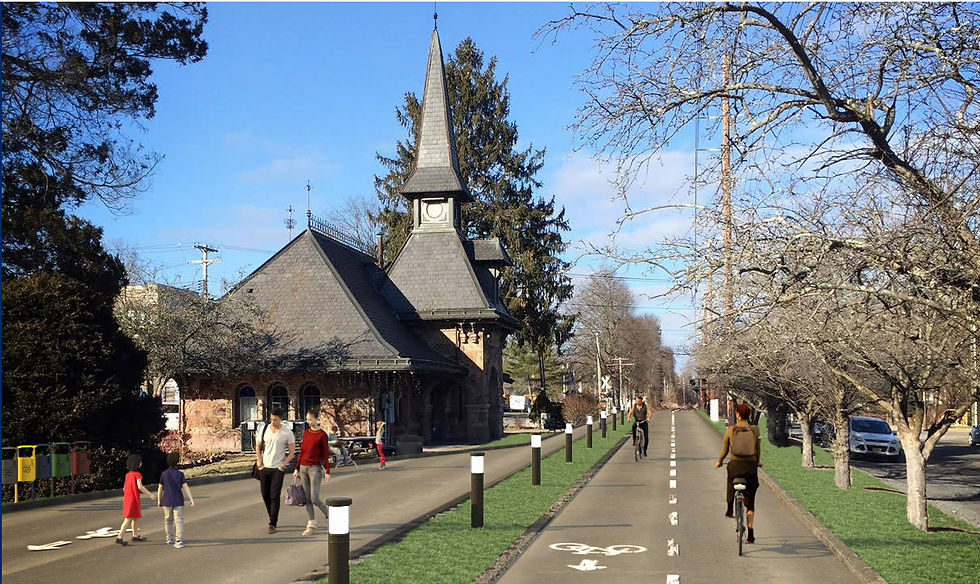
The conceptual design Mikesh described to me makes full use of the 60-foot right-of-way. Roughly half of that, about 30 feet, would be a high speed corridor featuring approximately 20 feet of asphalt for cyclists and a separate softer-surface path alongside for runners. The other 30 feet would function as a linear park, with greenery, rock gardens, exercise stations, seating, and other amenities bordering a path for walkers. Where the corridor narrows, uses would need to merge somewhat, but the design philosophy is to separate activity types and speeds wherever possible.

"All the faster users are over here, everybody slower is over there," Mikesh explained while showing me a concept design image for the greenway. "We're not mixing speeds." This is the prevailing philosophy in modern linear park design, and it's been implemented successfully in cities and towns globally.
Privacy barriers, most likely fencing rather than hedges (hedges are significantly more expensive), are part of the plan for the sections adjacent to private property. However, definite plans for privacy features at every section of the greenway have not been established. Similarly, the questions of hours, lighting, and law enforcement patrol haven’t been resolved yet, but Mikesh floated the idea of a cooperative police patrol coordinated between local departments as a natural way for officers to get some exercise while integrating security into the park's character rather than bolting it on.
At the 16 road crossings identified in the NJDOT study, the committee plans to bring in traffic engineers, develop proposed solutions, and hold community input sessions before anything is chosen. The point is not to hand down a single design from the top, but to let each town have some ownership over how the crossings work.
The design issues and concerns I mentioned above, such as privacy, road intersections, and security, are only a few of the many historically raised by residents. Mikesh didn’t give me definite answers for how the NVG planned to solve all these issues across the board, but explained that with so many places in the world having successfully executed similar projects, "We doubt there is anything in our towns that hasn't been solved somewhere in the world.” By taking inspiration from successful projects in countries with strong pedestrian and bike cultures, like the Netherlands and Denmark, the NVG hopes to tackle important design issues in proven, effective ways.
Each feature of the greenway, no matter how large, will be executed with a host of different users in mind. As Mikesh put it, the NVG will implement “a hundred different little community benefits" that push its community impact well beyond an ordinary bike path. For example high school and adult athletes currently running on public roads in low light and without sidewalks at times would receive provide a safe and reliable track for training. The NVG has already had conversations with local Boards of Education about this, and the response has been enthusiastic. A soft running surface, rubberized, absorptive material that's easier on joints than asphalt and doesn't get muddy, costs more to install, but Mikesh made clear that if funding allows, it's on the table.
When similar benefits stack up, they express extraordinary potential to permanently improve the whole region.
What Will It Cost?
The cost range Mikesh cited for construction is $1 million to $5 million per mile. At 7.4 to 8 miles, that puts total construction cost somewhere between roughly $7 million and $40 million before land acquisition, environmental remediation, or contingencies. The spread is wide because of genuine unknowns, seeing as the NVG won’t have the opportunity to conduct detailed studies of the railway corridor or draw up more definite designs until a deal is reached.
Whether the bridges need partial repair or full reconstruction, whether wetland sections require elevated boardwalks, whether the softer running surface gets funded, whether a given town wants more elaborate landscaping—none of these concerns can be priced until detailed assessments are complete. Additionally, cost increases since the 2018-2019 planning study haven't been factored in, simply because there isn't yet enough design specificity to apply them. "We can't really design it in enough detail to estimate it properly," Mikesh said. "We hope that as costs go up, funding will go up as well."
Who Owns It After It's Built?
This is genuinely unresolved, which Mikesh was candid about. While the towns do not want to absorb the ongoing cost of maintenance, Bergen County is a real possibility; the county already manages infrastructure through contracts with municipalities, with a model where the county funds and the towns execute (snow removal and road maintenance on County Road work roughly this way, with towns doing the actual plowing under county reimbursement). A similar arrangement could work for greenway maintenance.
An interlocal cooperative among the six towns is another option, as is eventual designation as a state park under ownership of the NJ Department of Environmental Protection, which owns and operates the Essex-Hudson Greenway as of that greenway’s acquisition. That said, local towns may resist that outcome; state ownership means less municipal control over how the greenway is developed and managed.
Mikesh’s position on what the communities should insist on, regardless of ownership structure, was clear: "If you leave it up to a government entity, you know what happens; they take the train track, put down a 12-foot-wide asphalt corridor in the middle, and call it a success. That's not what a sophisticated set of communities like ours should accept."
The Regional Picture
One dimension of the NVG that doesn't get enough attention in local coverage is what it could mean as a regional connector rather than just a local path.
To the north, the plan calls for a connection to the Joseph B. Clarke Rail-Trail in Rockland County, New York. Mikesh told me that CSX has indicated that if the NVG secures the New Jersey section of the Northern Branch line, the company may include a roughly quarter-mile segment on the New York side of the state line in the same deal, effectively closing the gap to the Clarke Trail at no additional acquisition cost. The Clarke Trail connects to New York State's broader trail network, which is a significant opening. Whether that opportunity actually comes through remains to be seen, but it's a meaningful possibility.
To the south, Mikesh asserts that connecting the NVG to Overpeck County Park has always been the goal, but the effort would face two major roadblocks. First, NJ Transit has had plans for a Hudson-Bergen Light Rail extension through Englewood for roughly 20 years. It's currently funded only for planning, but the Northern Branch right-of-way line through Englewood is already owned by NJ Transit, meaning the corridor the NVG would traditionally need to expand into Englewood is off the table.
Second, CSX still runs an active freight line through Englewood to Admiration Foods, a food processing company just south of Palisades Avenue. That's the same train that routinely stops traffic on Palisades Avenue, and another reason why the NVG design stops at the Tenafly-Englewood border. Getting from the NVG to Overpeck would require Englewood, Leonia, Teaneck, and other towns to build connections through roads on their own.
Beyond the immediate north-south connections, the NVG is part of two larger planning efforts. The Palisades Multi-Use Study, funded by New York State and the Palisades Interstate Park Commission, is planning an active transportation network from the George Washington Bridge to Nyack, and the NVG is part of that framework.
Furthermore, through the North Jersey Rail Network (a collaboration among the Rails-to-Trails Conservancy, the New Jersey Bike and Walk Coalition, and the NJ DEP) the NVG is being mapped as what Mikesh described as the primary connective active transportation corridor for this corner of the state. "We hope to hook up with the East Coast Greenway and a lot of other things," he said.
The "Rail Fantasy"
Ask Mikesh what the community most consistently gets wrong, and his answer is immediate: commuter rail.
"The biggest misconception is people who think that we can have rail service all the way up to the New York state line and commute to Manhattan," he said. The math doesn't add up; even reaching Tenafly from the city would require a transfer in Hoboken and onto a second train, making it a three-seat ride from the start. The Hudson-Bergen Light Rail extension that is already approved, stretching only as far as Englewood Hospital, carries a price tag of $1.2 to $1.8 billion just for that segment. Rebuilding the track north of Englewood as electrified rail, on a line that hasn't been maintained in years, could cost an estimated $100 million per mile north of Englewood. "There is no money, no political will, and almost no probability that rail service happens in the next 20 to 30 years," Mikesh said. Anything is possible over decades, he acknowledged, but the choice in front of the community right now is not between a greenway and a train. It's between a greenway and an abandoned, deteriorating rail corridor. "We either leave the corridor as unmaintained garbage, or we put it to use as a linear park. Those are the choices."
Mikesh, who grew up in Europe, states that he’s the last person to dismiss the value of good rail infrastructure. However, understanding its value is different from pretending the conditions for it exist in the present context.
NVG committee Tenafly representative Tenafly Ted Coleman added that parking and local tax concerns are the other recurring misconceptions. Historically, residents have feared that the greenway will drive up property taxes or consume scarce parking. He noted those have been addressed through the committee's ongoing public outreach.
Another common misconception, in Mikesh’s eyes, was that developing such an area could promote dangerous or undesired elements close to peoples’ homes. Mikesh acknowledged the tension but made the case that a developed, active greenway is actually safer for neighbors than the current abandoned corridor. "A nicely developed, controlled linear park with people in it is a lot safer than a set of tracks where people can do whatever at night right next to your property," he said. "Experience with other greenways bears that out."
Six Towns, One Coalition: The NVG Coalition
What has held this project together through years of slow-moving negotiations and shifting political conditions is the coalition of six municipalities working in alignment. Even beyond that core six, other surrounding towns have passed formal resolutions of support, alongside endorsements from local businesses and residents across the region.
Every participating town needs to stay equally invested in the outcome, which means no town gets prioritized over another in how construction is sequenced. That strategy of coalition management over convenience or ease was reflected in the decision to pursue a single, full-corridor land purchase rather than a phased one. CSX does not want to sell the rail corridor in pieces, and Mikesh doesn't think phasing would be sustainable. "If you start construction in phases and funding runs out, you end up with completed sections in some towns and nothing in others." That could spark protest and fracture the coalition.
The project began as a Rotary Club initiative, grew into a formal interlocal committee, and now has a 501(c)(3) nonprofit arm for fundraising. It has survived multiple election cycles across six boroughs without losing its institutional footing. Such durability is itself meaningful, and Mikesh is clear-eyed about why it matters. "This should be a project run by locals, for locals," he said. "The people who are going to be complaining if something goes wrong are our neighbors. We need them involved in how it gets done."
What Comes Next
The NVG is not about to immediately break ground. The months and likely years ahead will be dominated by the work of finalizing a land agreement with CSX and preparing for the due diligence stage; work is happening but has very little to show publicly until a deal is reached.
It's worth being direct about something that shaped the whole interview: a lot of the most specific questions, including final construction costs, exact trail dimensions, surface materials, bridge reconstruction plans, intersection treatments, maintenance structures, and long-term ownership, couldn't be answered. That wasn’t because Mikesh was being evasive, but because the answers don't exist yet.
As stated before, the land hasn't been purchased. Without a land deal, environmental and structural assessments can't happen. Without sound data on the condition of the railway corridor, detailed design can't be finalized. Without a final design, construction costs can't be estimated with any precision. Without cost estimates, grant applications and funding structures can't be built. Without funding locked in, governance and maintenance decisions are largely theoretical.
Every one of those questions sits downstream of the same bottleneck: the CSX acquisition.
"An agreement with CSX is what I would like to announce," Mikesh said at the close of the interview. "That is the next big thing. Everything else follows from that."
TownSquare thanks Andrew Mikesh and Chad Coleman for their time. Readers interested in supporting or learning more about the project can visit northernvalleygreenway.org.


Comments